Mission · The Framework
Prove that small farms win when they work as one.
Rural decline is not a single-sector problem, and it has never yielded to single-sector answers. The Kisan AI Regenerative Rural Transformation Framework treats it as one systems problem — and answers it with one operating architecture for land, water, energy, crops, animals, markets, skills, and governance.
Why this mission, why now
The trap that keeps farm families poor.
The trap is a loop. Tiny plots mean farmers sell alone. Selling alone means poor prices. Poor prices mean low income. Low income means nothing left to invest — and the children inherit an even smaller piece. Chittoor breaks the loop at its weakest link: teaming up. Nobody loses their land — they simply stop farming alone.
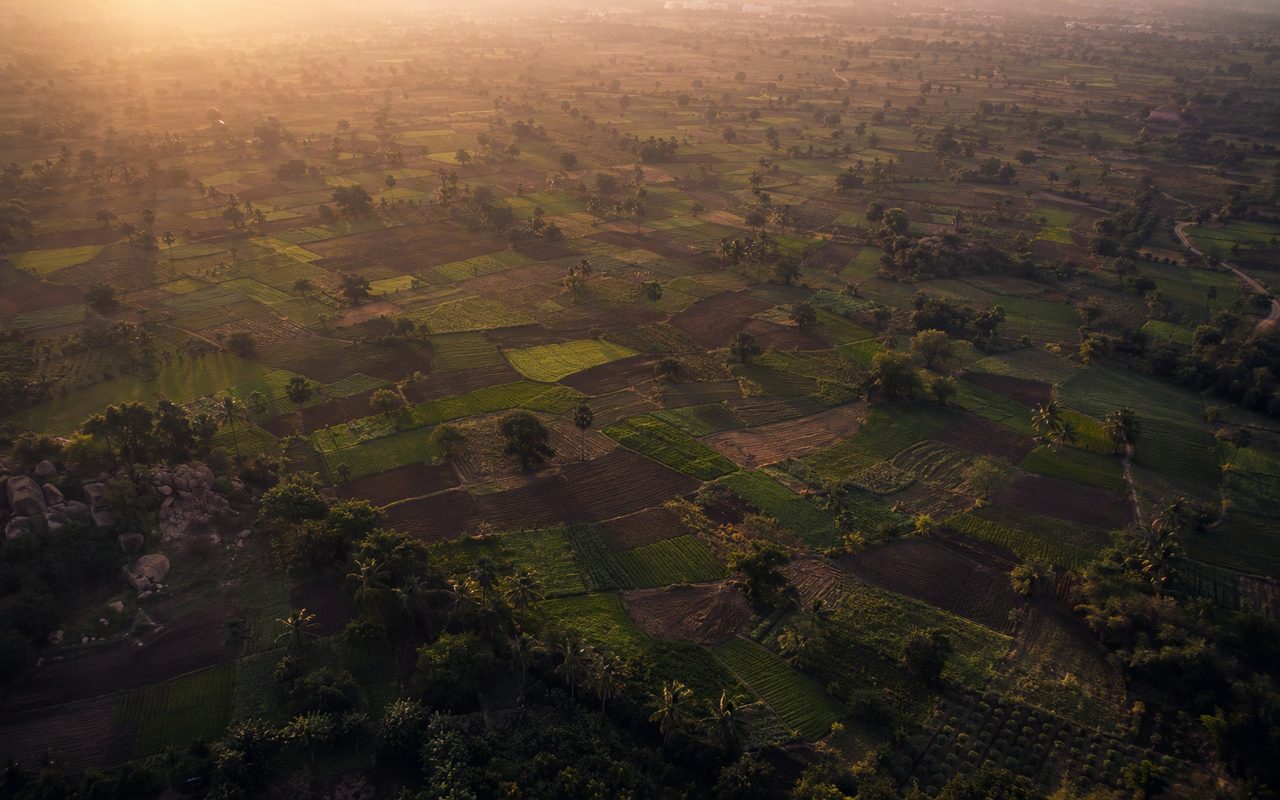
86% of India's farms are smaller than two hectares — and they shrink with every generation. Each piece is too small to bargain with, too costly to modernise, too risky to invest in.
Each farmer sells small lots on their own — no grading, no brand, no power to bargain. The average holding is about one football field per family.
Intermediaries take the margin. The person who grows the food earns the least from it — value leaves the village through middlemen, energy imports and unprocessed produce.
One bad season wipes out the year. Nothing is left to invest in the next one, and knowledge stays locked in individuals instead of becoming repeatable standards.
Young people see no future in the village and migrate — so the cycle tightens. The framework treats this as one systems problem, not five separate ones.
The mission, in four moves
Four moves that break the loop.
Team up
Small farms, one strong team. Farmers keep their own land but operate like one large estate — sharing machines, water, plans and prices. Ownership is never surrendered.
Earn many ways
Many income streams, one safe family. Crops, milk, solar, visitors and skills — if one fails, the others still pay. The balance sheet never rests on a single harvest.
Waste nothing
Nothing wasted, everything returned. Waste from one part feeds another — and every season leaves the land richer than it began, not poorer.
Fit tools to people
Technology that fits people — not the reverse. Farmr AI works in the local language, by voice and photo, with zero training — and a human expert always behind it.
"India's farms are small — but India's farmers were never the problem. Give a thousand small farms one system to work in, and they will beat any big estate."
Design principles
Seven principles that govern every deployment.
Participating land retains its ownership identity while shared infrastructure and institutional discipline create the economics of a large estate. Collective operations never depend on permanent transfer of land title.
Each operating cycle must improve at least one underlying asset — soil health, water resilience, vegetation, energy availability, skills, market access, household economics or institutional capability.
The rural balance sheet never depends on one harvest — income is diversified across nine streams, from crops and livestock to solar, processing, logistics and ecotourism.
Soil, water and energy are treated as operational loops that are instrumented — metered and measured — rather than simply described.
Education, skills, women's and youth participation and practical digital literacy are built in as infrastructure — the physical model cannot scale without local operating capability.
Voice-first, photo-first, role-specific workflows reduce cognitive and literacy barriers instead of exporting enterprise-software complexity into the field.
Every deployment is an instrumented operating environment. Replication decisions depend on defined evidence gates — not anecdotal success.
The nine domains
Every acre does nine jobs.
Most rural projects fix one thing — a crop, a pump, a loan. The framework connects everything, and each domain strengthens at least one other: the animals feed the soil, the soil feeds the crops, the crops feed the market, the market funds the school.
Every pond, plot and field sits on one map — fragmented geography converted into one operable unit while every owner keeps their identity.
One sowing and harvest plan for the whole campus, with long-duration tree assets that shade, feed and earn.
The herd diversifies income daily and strengthens the nutrient loop — milk in the morning, manure for the fields.
Rain is caught, stored and shared drop by drop — harvesting, recharge, irrigation efficiency and water budgeting protect the productive base.
Sunlight runs the pumps and processing loads — and the surplus is monetised, turning energy into a rural asset class.
Harvests are pooled, graded and connected to buyers — capturing value that used to leave the village.
Families, training and the village school — people grow here along with the crops, and migration becomes a choice.
Guests come to see a real working farm — landscape, culture, food and knowledge become income.
One digital diary for every task, rupee and record — coordinating work, preserving knowledge and measuring outcomes.
Deployment methodology
Evidence before replication.
The canonical sequence — Diagnose → Baseline → Design → Mobilize → Build → Operate → Digitize → Measure → Validate → Standardize → Replicate — runs through seven gates. A module scales only when its economics, adoption, operating feasibility and institutional readiness all clear the threshold.
Geography, land and beneficiary structure, water context, market access, community willingness, policy environment, delivery partners.
Dated, methodology-defined baselines for every KPI domain the program claims it will improve.
Select the relevant framework modules — not every geography requires every component.
Physical and digital readiness, synchronized: assets carry identifiers before measurement begins.
Operating cycles begin with field evidence capture built into routine workflows.
Performance evaluated against pre-agreed KPI definitions and evidence quality.
Scale only the modules whose economics, adoption and institutional readiness meet defined thresholds.
Join the mission
The mission needs partners, not spectators.
Whether you govern, fund, buy, teach or build — there is a clear, measured role for you inside a system that is already running.